
What is CJP? The Viral Party That Shook India in Just 48 Hours
India has witnessed many political movements over the decades, but none quite like this one. In May 2026, a question began trending across every social media platform in the country — what is CJP? Within 48 hours of its launch, the Cockroach Janata Party (CJP) had crossed 1 lakh members, gone viral on Instagram and X, and even attracted sitting Members of Parliament. If you’ve been seeing #CJP2029 everywhere and wondering what the buzz is all about, you’re in the right place. Let’s break down everything you need to know.
What is CJP? The Origin Story
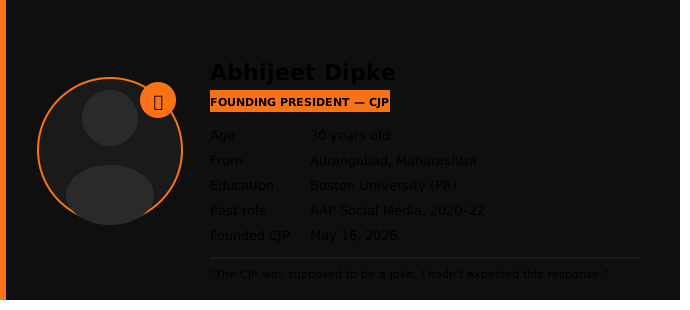
So, what is CJP and where did it come from? The Cockroach Janata Party — or CJP — is a satirical Indian political movement that was founded on May 16, 2026, by Abhijeet Dipke, a 30-year-old public relations student at Boston University and a former social media strategist for the Aam Aadmi Party (AAP).
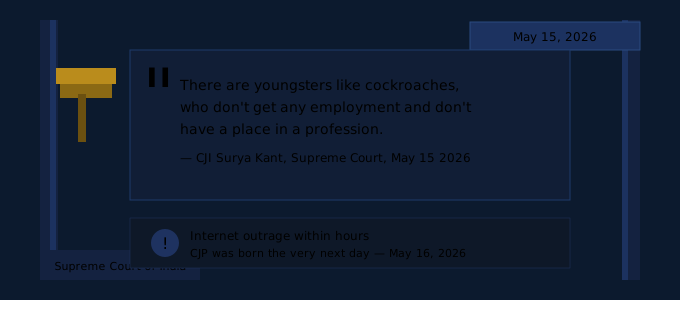
The story behind the CJP begins on May 15, 2026, during a Supreme Court hearing on fake law degrees. Chief Justice of India (CJI) Surya Kant made a remark that quickly set the internet on fire. He said: “There are youngsters like cockroaches, who don’t get any employment and don’t have a place in a profession. Some of them become media, some of them become RTI activists, and they start attacking everyone.”
The comment was intended to address a specific situation, but to millions of unemployed young Indians scrolling through their phones, it felt like a personal insult. The backlash was instant and massive.
Within 24 hours, Abhijeet Dipke had launched what he called “a platform for all the cockroaches out there.” That platform became the CJP — and India has not stopped talking about it since.
For visit-https://cockroachjantaparty.org/
What is CJP Really About?
If you’re still asking what is CJP at its core, here’s the simplest answer: it is a satirical, meme-driven online political movement that represents India’s unemployed, frustrated, and digitally active youth.
The CJP describes itself as “a political front of the youth, by the youth, for the youth — Secular, Socialist, Democratic, and Lazy.” Its motto is simple: Unity. Resilience. Progress. Its website boldly states: “A political party for the people the system forgot to count. Five demands. Zero sponsors. One large, stubborn swarm.”
While the name and tone are deliberately humorous, what is CJP doing in terms of real demands? Quite a lot, actually. Despite being born as a joke, the party quickly evolved into something that many young Indians are taking seriously — at least emotionally.
Also visit-https://chrogoo.in/big-dreams-small-fees-best-private-engineering-colleges-for-every-budget/
Who Founded CJP?
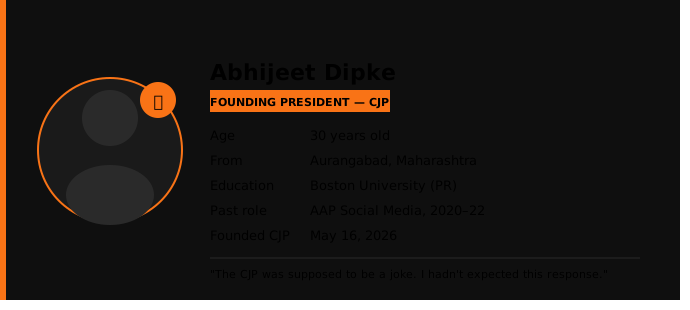
Understanding what is CJP also means understanding the man behind it. Abhijeet Dipke, originally from Aurangabad, Maharashtra, studied journalism in Pune before moving to the United States to pursue a Master’s in Public Relations at Boston University. Between 2020 and 2022, he worked on viral meme-based content for the Aam Aadmi Party’s social media campaigns during the Delhi Assembly elections.
When the CJI’s remarks went viral, Dipke acted fast. He set up the CJP website, created social media accounts on X and Instagram, and posted his first message with eligibility criteria that were equal parts funny and relatable: “Unemployed. Lazy. Chronically online. Ability to rant professionally.”
Dipke himself was shocked by the response. He said: “The Cockroach Janta Party was supposed to be a joke. But I had not expected it would draw such an encouraging response.” He has also admitted: “I am not delusional; I know this can die out in a few days.” But for now, the swarm is very much alive.
The CJP Manifesto — Five Bold Demands
A big reason what is CJP has become such a trending topic is its surprisingly sharp five-point manifesto. Despite being launched as satire, the demands touch on very real political concerns:
1. No Rajya Sabha Seat for Retiring Chief Justices The CJP demands that no Chief Justice shall be granted a Rajya Sabha seat as a post-retirement reward — a direct dig at the practice of rewarding judges with political positions.
2. CEC Accountability Under UAPA If any legitimate vote is deleted, the Chief Election Commissioner shall be arrested under the Unlawful Activities (Prevention) Act (UAPA), because taking away voting rights is “no less than terrorism.”
3. 50% Women’s Reservation Women shall receive 50% reservation — not the existing 33% — without increasing the total strength of Parliament. Additionally, 50% of all Cabinet positions shall be reserved for women.
4. Independent Media All media houses owned by the Adani and Ambani groups shall have their licences cancelled to make way for truly independent media. Bank accounts of so-called “Godi media anchors” shall be investigated.
5. Anti-Defection Law Any MLA or MP who defects from one party to another shall be barred from contesting elections and from holding any public office for 20 years.
These five demands explain why what is CJP became more than just a meme — it tapped into genuine political frustration.
CJP’s Lightning-Fast Growth — By the Numbers
To truly grasp what is CJP‘s impact, look at the numbers. The speed of its growth was unlike anything India’s political internet had seen:
- Day 1 (May 16): CJP launched with a casual social media post
- 48 hours later: Over 25,000 registered members, a website, a party anthem, and an election symbol
- 72 hours later: Over 1 lakh (100,000) registered members
- Instagram: 4,20,000+ followers within days
- X (formerly Twitter): 38,000+ followers
Two sitting Trinamool Congress MPs — Mahua Moitra and Kirti Azad — publicly expressed interest in joining. Moitra posted: “I too would like to join the CJP (besides being a card-carrying member of the Anti-National Party).” The CJP responded: “You are the fighter democracy needs, Mahua Moitra.”
Why Did CJP Go Viral So Fast?
What is CJP without understanding why it exploded the way it did? Several factors came together at the perfect moment:
Relatable anger: Millions of young Indians are dealing with unemployment, economic anxiety, and a sense of being ignored by institutions. The CJI’s remark felt like the final straw.
Perfect timing: The remark happened when Gen Z was already frustrated with existing political parties and looking for a way to express that frustration online.
Meme culture: CJP’s entire identity was built around internet humor. Its posts combined memes, political satire, and genuine commentary — the exact formula that spreads fast online.
Political star power: When prominent politicians like Mahua Moitra jumped on the trend, it gave CJP mainstream credibility almost overnight.
Low barrier to entry: Joining CJP was free, online, and instant — the perfect recipe for mass participation.
Is CJP a Real Political Party?
This is one of the most common questions people have after learning what is CJP. The answer is: not yet, officially. The CJP is not registered with the Election Commission of India and openly describes itself as a satirical political movement and a public-pressure campaign. It does not have a physical office, funding, or formal party structure.
However, the movement is real in terms of its membership, its manifesto, and its growing offline presence. Photographs of young people cleaning public spaces while wearing placards reading “I am a cockroach” circulated widely. The CJP was floating ideas of a digital convention, a march of the unemployed, and a GenZ National Convention.
Whether what is CJP today will become a formal political force by 2029 — as its hashtag #CJP2029 suggests — remains to be seen.
What is CJP’s Message to India’s Youth?
At its heart, what is CJP is a mirror held up to the system. It tells India’s institutions that the youth are watching, are aware, and refuse to be silenced — or squashed.
The CJP’s vision statement puts it powerfully: “We are not here to set up another PM CARES, holiday in Davos on the taxpayer’s salary slip, or rebrand corruption as ‘strategic spending.’ We are here to ask — loudly, repeatedly, in writing — where the money went.”
That message has clearly resonated. When young people who feel “chronically online,” unemployed, and overlooked by politicians suddenly find a platform that speaks their language — in memes, in satire, in honest anger — they rally behind it. What is CJP if not proof that India’s youth are politically aware, just politically disillusioned?
CJP and the Bigger Picture
What is CJP also tells us something important about India’s changing political landscape. Traditional parties are struggling to connect with younger voters. Gen Z consumes politics through reels and tweets, not rallies. They trust satire more than speeches.
The CJP, knowingly or not, has exposed a massive gap between India’s political establishment and its youth. Even if the party fades, the conversation it has started — about unemployment, judicial accountability, media freedom, and democratic participation — is not going away.
RTI activist Anjali Bhardwaj even submitted suggestions to the CJP, which the party quickly adopted: full accountability under the RTI Act, no anonymous donations, and no secret funds. That a serious activist engaged with a satirical party shows just how seriously people are taking the movement behind the jokes.
Conclusion
So, what is CJP? It is a joke that became a movement, a meme that became a manifesto, and a satirical party that became the voice of a generation. Born in response to a single careless remark by the Chief Justice of India, the Cockroach Janata Party grew to over 1 lakh members in just 72 hours — making it one of the fastest-growing political movements in India’s digital history.
Whether you see what is CJP as a serious political force or just a viral moment, one thing is undeniable: it has made India’s power structures uncomfortable, and that alone might be the point. The cockroaches have spoken. The question now is — will anyone in power actually listen?
FAQ — What is CJP?
Q1. What is CJP full form? CJP stands for Cockroach Janata Party. It is a satirical Indian political movement that went viral in May 2026.
Q2. Who founded the CJP? CJP was founded by Abhijeet Dipke, a 30-year-old public relations student at Boston University and former AAP social media strategist, on May 16, 2026.
Q3. Why was CJP formed? CJP was formed in response to remarks made by Chief Justice of India Surya Kant on May 15, 2026, in which he compared unemployed youth to “cockroaches and parasites.”
Q4. How many members does CJP have? Within 72 hours of its launch, CJP gained over 1 lakh (100,000) registered members along with 4,20,000+ Instagram followers.
Q5. Is CJP a registered political party? No. CJP is not registered with the Election Commission of India. It describes itself as a satirical political movement and public-pressure campaign.
Q6. What are CJP’s five demands? CJP’s five demands are: no Rajya Sabha seats for retiring Chief Justices, CEC accountability under UAPA, 50% women’s reservation, cancellation of licences for Adani/Ambani-owned media, and a 20-year ban on defecting politicians.
Q7. Can I join CJP? Yes! Membership is free and open to everyone. You can join through the official CJP website. Eligibility: unemployed, lazy, chronically online, or just angry at the system.
Q8. What does #CJP2029 mean? #CJP2029 is the party’s hashtag, hinting at its aspirations to be a political force by the 2029 Indian general elections.
Disclaimer: This blog is for informational purposes only. The CJP is a satirical movement and is not a registered political party in India.