
The CJP End Game: Can the Movement Survive the Backlash?
In May 2026, a strange and unprecedented phenomenon completely disrupted India’s digital and political landscape: the meteoric rise of the Cockroach Janta Party (CJP). What started as a tongue-in-cheek response to a controversial remark by Chief Justice of India (CJI) Surya Kant—who during a court hearing compared certain unemployed youth to “cockroaches” and “parasites of society”—exploded into a massive countercultural movement. Within a mere 78 hours, the CJP’s Instagram page racked up over 20 million followers, eclipsing the digital footprints of established political titans like the Bharatiya Janata Party (BJP) and the Indian National Congress (INC).
But as the initial euphoria of viral memes settles, the movement faces structural pushback, official bans, and a coordinated counter-narrative from institutional critics. Can the Movement Survive the Backlash? This central question now hangs heavily over the millions of Gen Z and millennial supporters who claimed the derogatory label as a badge of honor. To understand if this network-driven phenomenon has an end game, or if it is destined to burn out, we must dissect the multi-layered backlash it faces and analyze its internal structural vulnerabilities.
1. The Shockwaves of the Institutional Crackdown
The primary threat to the longevity of the Cockroach Janta Party is the sweeping institutional crackdown initiated by governmental machinery. For a movement that lives, breathes, and communicates entirely in the digital sphere, infrastructure is life.
Within five days of its launch, the central government moved aggressively against the platform:
- The CJP’s official X (formerly Twitter) account was withheld in India under Section 69(A) of the Information Technology Act, citing national security concerns.
- Shortly after, the official website, which had logged over 350,000 membership sign-ups via Google Forms, was taken down.
- Founder Abhijeet Dipke reported that both his personal and the movement’s primary Instagram handles faced hacking attempts and targeted digital suppression.
When analyzing if Can the Movement Survive the Backlash?, this platform-level vulnerability is the most immediate roadblock. Traditional political entities can survive state crackdowns because they possess physical infrastructure—offices, local cadres, and face-to-face community networks. In contrast, a purely decentralized, network-driven mass uprising relies on the stability of corporate social media algorithms. When the state chokes those channels, it severs the nervous system of the movement.
2. The Narrative War: Co-optation and “Foreign Plot” Allegations
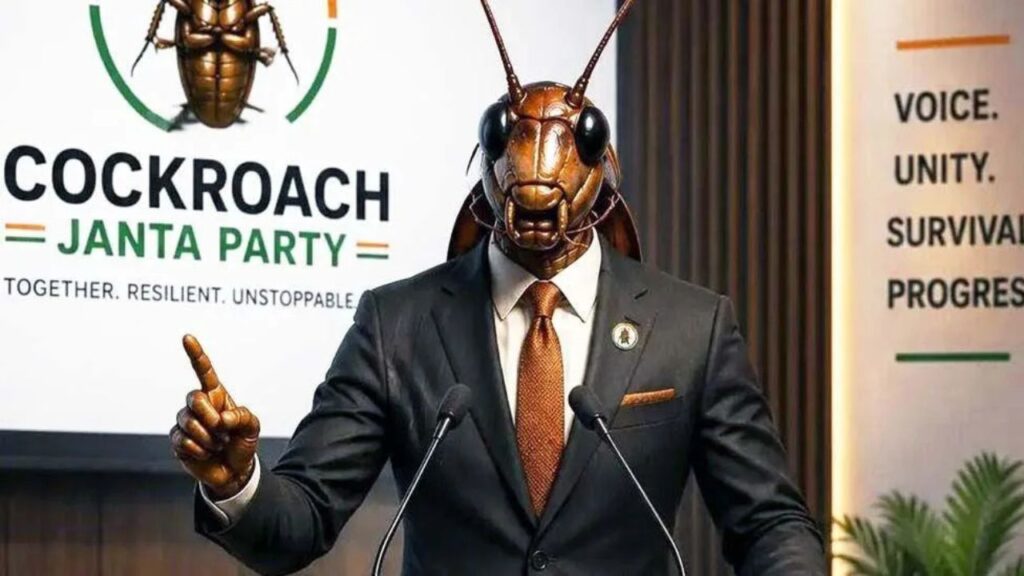
Beyond legal bans, the CJP faces a sophisticated, two-pronged narrative assault designed to delegitimize its core message.
The “Foreign Conspiracy” Label
Government-aligned critics and state officials quickly labeled the rapid accumulation of millions of followers as “abnormal” and artificially inflated. Kanchan Gupta, a senior adviser at the Ministry of Information, noted that the government was investigating the phenomenon under the suspicion that the accounts were primarily foreign bots, hinting at a premeditated geopolitical conspiracy to destabilize national democratic harmony.
While Dipke countered with analytics showing that 95% of traffic originated within India, the “foreign plot” narrative remains an effective tool to turn mainstream, nationalistic audiences against the movement. If the public perceives a genuine youth protest as an external psy-op, it severely limits the movement’s capacity to expand beyond the “chronically online” demographic.
The Ground Reality Check vs. Political Co-optation
The second arm of the narrative backlash comes from traditional political wings. The Indian Youth Congress (IYC), for instance, launched its own “Indian Youth Cockroaches” campaign to explicitly target the CJP’s lack of physical presence. By organizing street demonstrations against the UGC-NEET 2026 exam paper leaks, the Youth Congress positioned itself as the “real cockroach,” asserting that real change cannot be won by online revolutionaries sitting behind keyboards.
This creates a critical ideological squeeze. When establishment opposition parties co-opt the aesthetics of a satire movement, the original movement risks losing its unique identity, fading into the background noise of standard partisan politics.
3. Ideological Limits of “Democratic Laziness”

The CJP’s manifesto is incredibly sharp. Built using advanced generative AI tools like Claude and ChatGPT, it outlines five core, radical demands that speak directly to genuine youth grievances:
- No post-retirement rewards: A complete ban on granting Rajya Sabha seats to retired Chief Justices.
- Voter Protection: The arrest of the Chief Election Commissioner under the UAPA if any legitimate vote is deleted.
- Gender Parity: Strict 50% reservation for women in Parliament and Cabinet positions.
- Media De-monopolization: The cancellation of broadcasting licenses for corporate conglomerates to foster independent journalism.
- Accountability: Full answerability under the Right to Information (RTI) Act and a ban on anonymous political donations.
Despite these heavy hitting points, the movement frames its internal identity around satirically elite criteria: being unemployed, physically lazy, and online for at least 11 hours a day.
While this self-deprecating humor acts as an excellent shield against standard political attacks, it introduces a major structural bottleneck. Can the Movement Survive the Backlash? Not if it remains trapped in pure ironism. Satire is highly effective for deconstructing institutional hypocrisy, but it struggles to build sustainable, constructive long-term frameworks. To survive an organized onslaught from the world’s largest political organizations, a movement eventually requires structural discipline, resource allocation, and a strategic transition from digital performance to tangible policy impact.
A Comparative Look at Modern Youth Desperation
To contextualize the CJP’s structural position within the broader political landscape, we can compare its traits against traditional political parties and recent global youth protest models (such as those in Bangladesh or Nepal):
| Feature / Dynamic | Traditional Parties (BJP / INC) | Global Youth Protests (Physical) | Cockroach Janta Party (CJP) |
| Primary Arena | Ground rallies, booths, mainstream TV | Streets, university campuses, public squares | Instagram, X, digital web spaces |
| Core Mobilizer | Ideology, leadership, patronage networks | Direct systemic threats (Quotas, inflation) | Memes, shared economic frustration, AI art |
| Vulnerability to State | Low (Protected by institutional status) | High (Physical violence, arrests, curfews) | Critical (Platform bans, algorithmic shadowbans) |
| Financing Structure | Electoral bonds, massive corporate backing | Crowdfunded, decentralized local pools | Zero-cost digital organic reach, self-funded |
| Longevity Model | High (Decade-spanning institutional permanence) | Medium (Tends to dissolve after policy change) | Unproven (Highly vulnerable to rapid attention shifts) |
The table clearly illustrates the underlying paradox: while the CJP enjoys an incredibly low-cost, high-velocity distribution model that allows it to bypass traditional corporate media gatekeepers, its hyper-dependence on digital ecosystems leaves it uniquely exposed to coordinated digital blockades.
The Strategic Path Forward: The Transition Phase
For the Cockroach Janta Party to answer the question of Can the Movement Survive the Backlash? with a definitive yes, its leadership must execute a careful, calculated transition. Founder Abhijeet Dipke has explicitly stated that the movement does not intend to transform into a traditional, brick-and-mortar political party, emphasizing that Gen Z would reject standard political hierarchies.
Instead, the CJP’s survival strategy hinges on shifting from passive meme consumption to active civic pressure. We can map out this potential evolution across three critical operational phases:
Phase 1: Issue-Based Campaign Scaling
Instead of trying to fight broad ideological wars, the movement is successfully anchoring itself to distinct, tangible issues that matter to its base. Its ongoing digital petition demanding the accountability and resignation of Union Education Minister Dharmendra Pradhan over the massive NEET-UG 2026 paper leak row amassed over 600,000 signatures in days. By focusing heavily on educational corruption and structural unemployment, the platform turns abstract internet rage into organized, focused civic demands.
Phase 2: Decoupled Infrastructure
To survive state-level censorship, the movement must build independent digital infrastructure. Relying solely on a centralized Instagram account or a single domain name makes it a sitting duck for Section 69(A) IT Act orders. Moving toward distributed communication channels, encrypted group networks, and decentralized web hosting will protect its content distribution from top-down censorship.
Phase 3: Strategic Alliances Without Absorbment
While the movement must reject absorption by traditional political machines, it can selectively leverage endorsements from sympathetic cultural icons and public figures. Endorsements from independent filmmakers like Anurag Kashyap, comedians like Kunal Kamra, and prominent opposition MPs have given the movement a layer of mainstream legitimacy. The trick is maintaining its fiercely independent identity while utilizing these public platforms to push its specific five-point manifesto.
“The Cockroach Janta Party is an internet joke that became a mirror. It highlights a defining reality of modern Indian politics: when traditional avenues of dissent feel dismissive or completely blocked, the youth will weaponize digital culture to force a raw, unfiltered conversation.”
Conclusion: The Resilient Nature of the Mascot

Ultimately, when assessing Can the Movement Survive the Backlash?, the answer lies in the very symbolism of the mascot its founders chose. Cockroaches are evolutionary marvels—unwanted, universally reviled by elites, incredibly difficult to eliminate, and capable of surviving extreme atmospheric trauma. By adopting this metaphor, India’s internet-native generation has built a digital nervous system that thrives on hostility.
The institutional backlash may successfully take down websites, ban accounts, and launch massive counter-propaganda campaigns, but it cannot easily erase the deep-seated socioeconomic anxieties—the 29.1% graduate unemployment rate, the burnout of competitive exam leaks, and the sense of economic stagnation—that birthed the movement. Even if the current iteration of the CJP is suppressed, the underlying network architecture of meme politics has permanently altered the rules of civic engagement in India. The “End Game” for the CJP is not a destination; it is an ongoing battle for the control of public attention, and as long as the core grievances remain unaddressed, this digital counterculture will continue to replicate, mutate, and survive.
Frequently Asked Questions (FAQs)
What exactly is the Cockroach Janta Party (CJP)?
The Cockroach Janta Party (CJP) is a viral, satirical Indian youth movement launched on May 16, 2026, by digital communications strategist Abhijeet Dipke. It uses internet memes, AI-generated art, and sharp satire to protest systemic youth unemployment, institutional elitism, and corruption.
Why is it called the “Cockroach” party?
The name was chosen in direct retaliation to a comment made on May 15, 2026, by India’s Chief Justice Surya Kant, who allegedly compared unemployed, active social media youth to “cockroaches” and “parasites.” The movement took the insult and turned it into an ironic symbol of resilience.
Can the Movement Survive the Backlash?
Can the Movement Survive the Backlash? Yes, but its long-term survival depends entirely on its ability to diversify its digital platforms, move beyond pure ironism into issue-based civic mobilization (like the NEET exam protest petitions), and protect its digital infrastructure from government-mandated blocks under the IT Act.
Is the CJP an officially registered political party in India?
No. The CJP is not a registered political entity and has explicitly stated it has no intentions of contesting traditional elections or inducting career politicians. It operates strictly as a countercultural digital pressure group.
How has the Indian government responded to the movement?
The government has treated the movement with significant caution, executing platform-level restrictions including withholding the CJP’s official X account within India and taking down its primary membership website under national security guidelines, while alleging potential foreign bot interference.